
Fist and feather
Chumash illustrator John Khus highlights cultural heritage, fight for social justice with colorful imagery, bizarre black-and-white political statements

WHEN PEN MEETS PAD: Chumash artist John Khus has been keeping the spirits of his Central Coast ancestors alive for over four decades with a rainbow collection of Native symbols scattered throughout his work. His unusual, amusing drawings of peculiar characters serve as political statements to a world that hasn’t always given his people full respect. You can find him on Instagram @john.khus.
A faceless Statue of Liberty with flowing, black hair dons a colorful array of Indigenous tattoos across her body. The white “Be Human” book she holds in her right hand matches the shackle around her left ankle, chaining her to the pile of skulls on which she stands.
Her blank head looks back at the viewer, while her naked, Rubenesque body faces the United States Capitol, which is turning into an army of police drones flashing red and blue lights. The Abendrot-colored sky surrounding the drones abruptly turns to a mix of indigo, burgundy, vermilion, and merigold, as the water body of water that separates her in the foreground from the Capitol in the background reflects a rainbow.
Chumash artist John Khus has been depicting Native imagery across the Central Coast for over four decades. Known for his bizarre, horrifying, black-and-white illustrations that combine several ideas, reactions, cultural images, or parts of a story into one unique and impossible-to-describe image, he enjoys making political statements with his art.
“I named that piece Be Human because I don't think that there's anything more radical someone can do than just be human,” Khus said. “Once you're human, you recognize the value of other humans, and you don’t keep silent.”
While he likes to play with color for special projects like his Be Human drawing, Khus said he feels most comfortable drawing with a pen on paper. He said he started drawing because his mom would carry legal pads and pens around when they lived in San Francisco for her to attend law school during his youth in the 70s.
Instead of accepting a scholarship from the San Francisco Art Institute, Khus joined the military after high school. Influenced by uncles who fought in Korea and Vietnam, he served three years in the Marine Corps. and three years in the army from 1983 to 1989, going to Panama for jungle survival training with the 82nd Airborne Division right before Operation Just Cause, the United States’ invasion of Panama on Dec. 20, 1989.
“I still did art when I was in the military,” Khus said. “When I was out in the field, I’d take every opportunity to sketch and draw.”
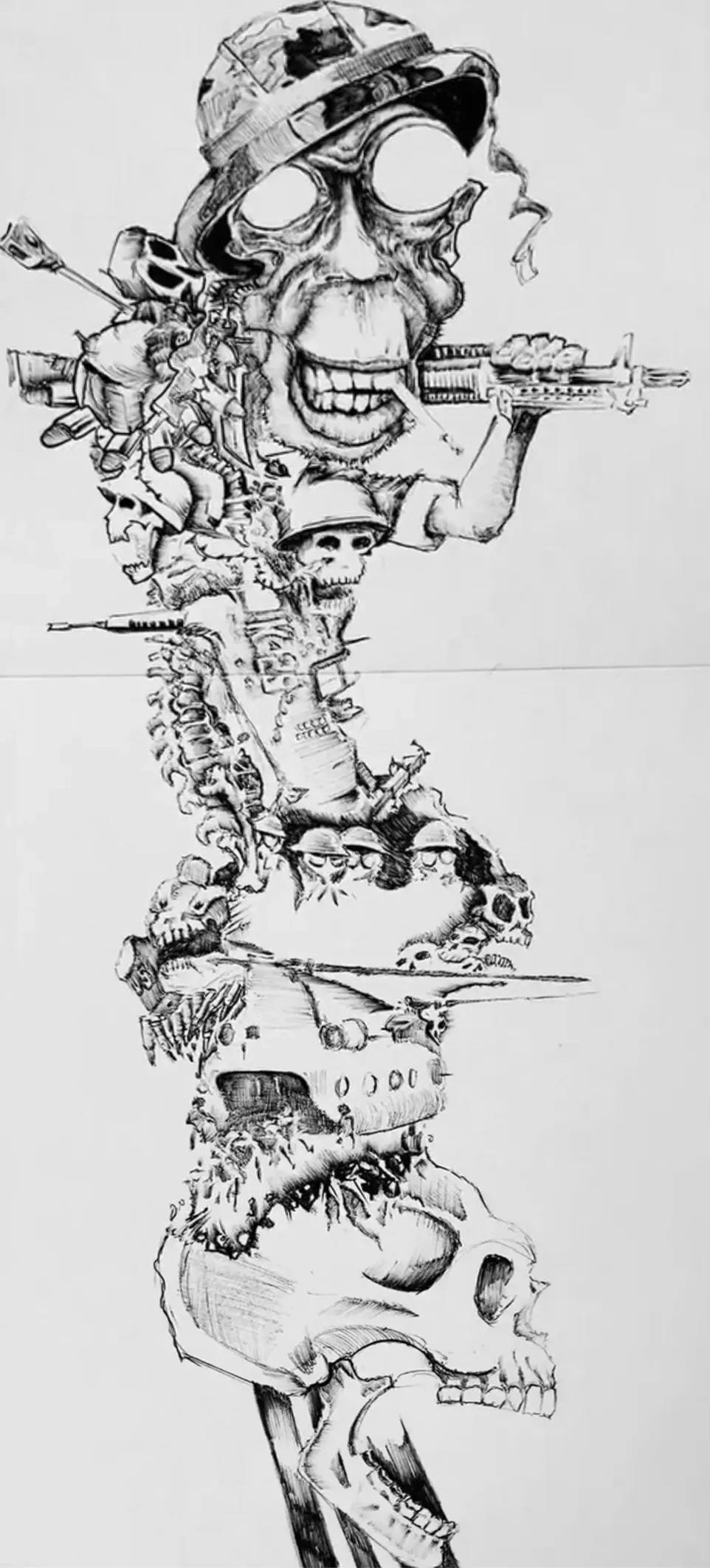
Pieces like his Pig Gunner drawing showcase his preferred pen-on-paper style and his turbulent time in the armed forces.
Termed during the Vietnam War to describe soldiers who carry the M60 machine gun—due to its heavy weight and voracious appetite to kill—Khus’ pig gunner stands on a body of screaming helmeted skulls, soldiers rushing out of a helicopter, bullets, guns, knives, flames, and a fighter plane mashed together. His blank, white eyes and eerie smile highlight the skin-crawling sense of annihilation and suffering captured in the piece.
Another political drawing, Khus’ Election [on stolen land] Day shows a man without skin on his face holding his left eyeball in his hand as blood with the words “obey” and “consume” spill from his socket and gums, respectively.
Khus’ Uncle Sam Says Buy Genocide illustration personifies the U.S. as more of a horrifying alien than a man.
Eyeballs, teeth, and screaming homunculi emerge from around Uncle Sam’s neck as he firmly grasps an American flag and points his index finger forward. Like the Statue of Liberty, he too stands on a bed of skulls. This time, they match the one atop his flag pole.
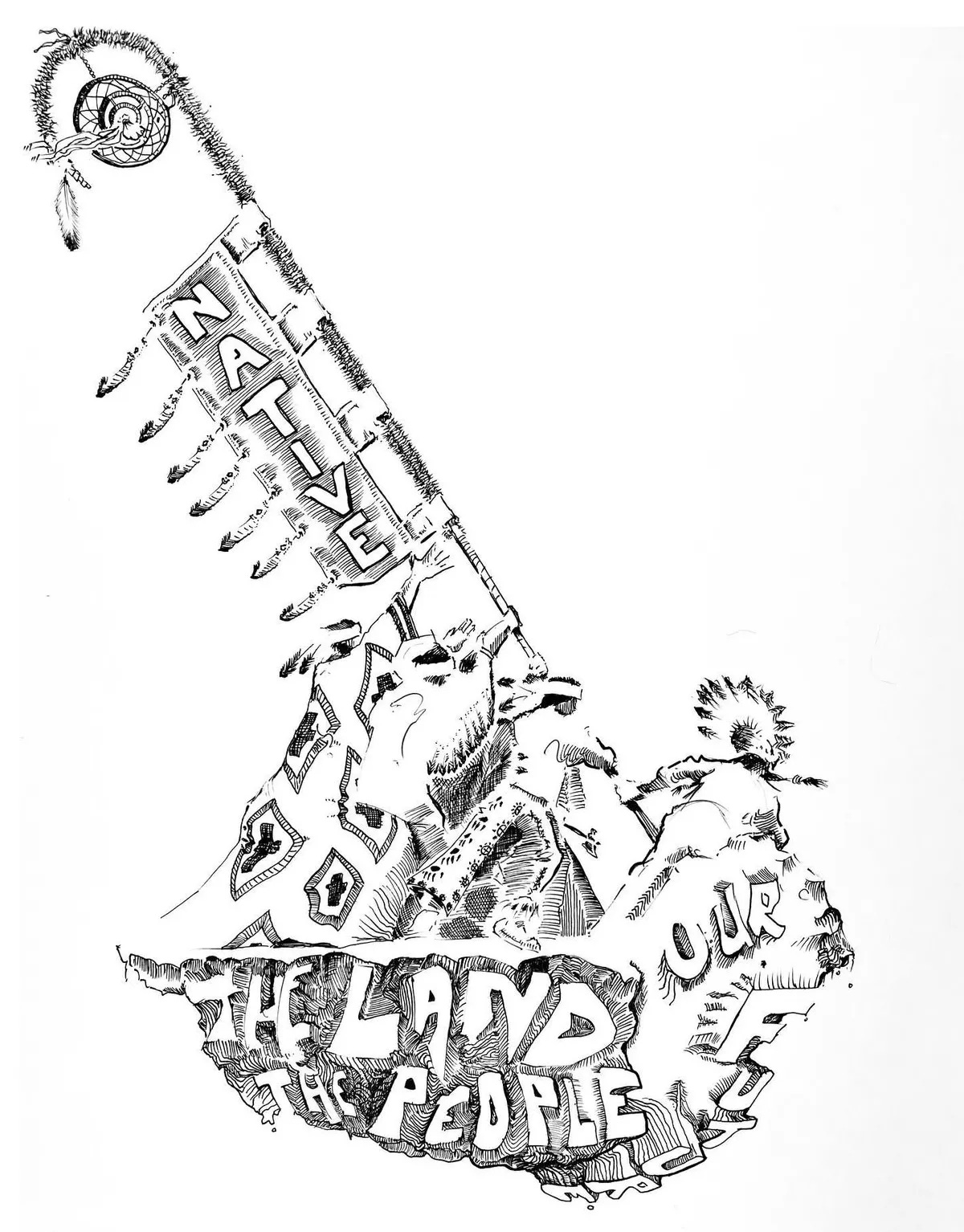
On the brighter side, Khus’ Semper Fidelis illustration, a tribute to his time in the Marine Corps, depicts a spirit of resistance and cultural preservation.
In it, Khus reimagined the Pulitzer Prize-winning photograph, “Raising the Flag on Iwo Jima,” to depict Indigenous Americans raising a flag that says “Native,” while standing on a bed of rock that reads: “the land,” “the people,” and “our future.”
Always thinking of his Native heritage, Khus loves to include specific, little-known cultural references in his work. His Hatuey Ascended to the Ancestors By Refusing the Lies piece reimagines the heartbreaking tale of the rebellious Indigenous chief burned at the stake.
After initially struggling with whether to depict Chumash rock art in his illustrations, Khus said his mother told him to design his own. His Modern Rock Artist depicts a traditional Chumash cave painter wearing the suit of a present-day businessman.
“If I ever wear a suit, view it as the chains of colonial society and count me amongst the dead. It will never happen again,” Khus wrote in an Instagram post sharing the piece. “Stay strong. Stay free. Stay human.”
A lover of the outdoors, Khus also enjoys illustrating nature.
His Winter and Spring piece shows a sudden change of seasons at the Carrizo Plain National Monument.
A field of gold and tangerine flowers leads into a brown, burnt orange, and Kelly green mishmash of feathers and cave symbols. The almond face on the left side turns cerulean on the right, as a matching squeezed fist emerges on the navy background like a wave splash from the cobalt clouds, which also produce white lightning striking the midnight green mountains below. Khus shared a time-lapse video on Instagram showing the piece from start to finish for anyone interested.
Like most nature lovers, Khus has a big heart for animals. He loves using their imagery in his pieces.
Inspired by his pet, Bodhisattva, Khus sketched what it feels like to walk a cat in December 2023. His Hanging Out With My Relatives; Crow Spirit Wearing Moccasin Sneakers; and The Father, Son, and Holy Crow pieces all depict the dark wisdom symbolized by the black bird.
Embodying the collective spirit of his Chumash ancestors, Khus also creates illustrations to give back to his Central Coast community.
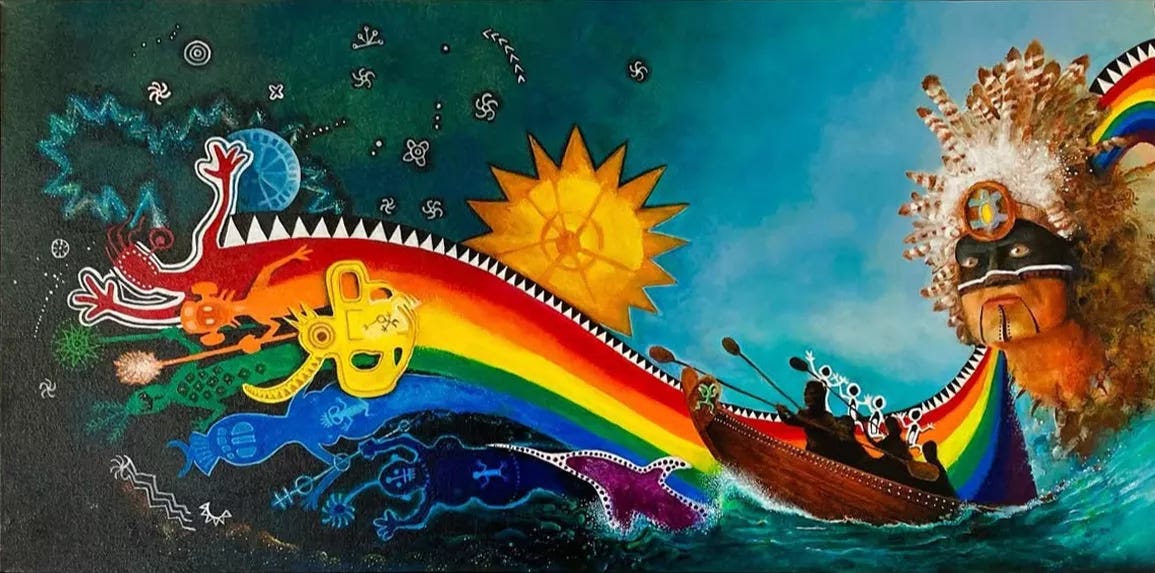
In August 2023, he designed the “Tomol Rides Wishtoyo” mural at the Cambria Post Office with the help of Beautify Cambria and the local Chumash community.
A Chumash elder watches human spirits in a traditional tomol, or canoe, pass over the Wishtoyo, also known as the rainbow bridge, to join their ancestors. Along with the black and white rock painting and violet swordfish, Chumash symbols are speckled throughout the mural, depicting spirits like the indigo chief carrying a child in her womb, blue moon, yellow sun, green lizard chief, orange grandfather, and red artist.
The mural was designated to celebrate the tribe’s work in certifying the Chumash Heritage National Marine Sanctuary, officially designated Nov. 30, 2024. Khus said the original painting on which the mural is based is displayed inside the post office for anyone interested.
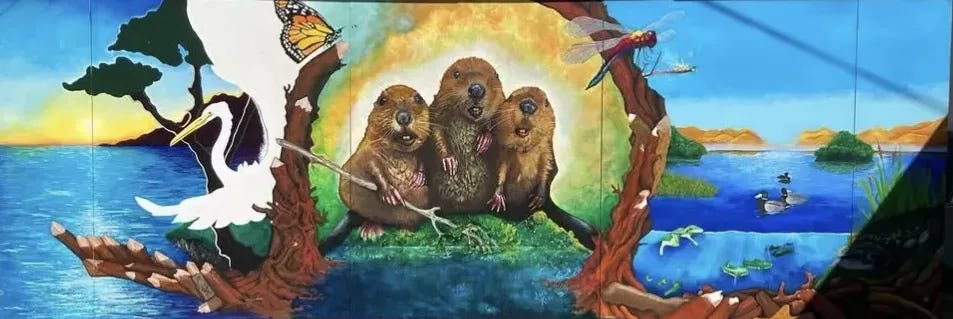
In April 2024, he unveiled his mural at the Central Coast Zoo in Atascadero with the SLO Beaver Brigade.
Three beavers sit at the grassy center of the painting divided into thirds by wooden dam partitions. The waterway and sunrise scenes beside them include a monarch butterfly, flame skimmers, a pelican, frogs, bass, and a lizard.
Last December, Khus curated the first Indigenous DNA: Decolonized Native Art exhibit in Santa Barbara, hosting dozens of local Native artists’ pieces in the Olson Gallery of the Santa Barbara Community Arts Workshop for a week. He said he’s currently working on putting together a second exhibit for later this year.
“When I was growing up and looking out at the world, I realized [we] humans have an obligation to be a beneficial part of it and contribute benefits,” Khus said. “Those encouragements come from my Chumash background.”
*This story was originally published July 10, 2025, at https://www.santamariasun.com/arts/chumash-illustrator-john-khus-highlights-cultural-heritage-fight-for-social-justice-with-colorful-imagery-16659292
He definitely respects his heritage. Great article!!!!!